Shock Loss After a Hair Transplant: Why Hair Falls Out Before It Grows
Hair transplant shock loss is usually temporary shedding after surgery. Dr Tyng Tan explains why it happens, regrowth timelines and when to seek review.
Hair transplant shock loss is usually temporary shedding that can happen in the weeks after surgery. One main mechanism is the response of follicles to surgical stress, which moves a group of them into a resting phase and releases the visible hair shafts. In shock loss, the affected follicles typically remain beneath the skin. Transplanted hair and nearby native hair can both be affected. New growth may begin to appear around the third to fourth month, although individual timelines vary.
A few weeks after a hair transplant, you may find short hairs on the towel after washing your head. It is easy to look at them and think the grafts are coming out. Early shedding can happen while the follicles themselves stay in place beneath the skin.
The word shock refers to the physical trigger that affects the follicle. It does not tell you how severe the outcome will be.
That distinction matters when the treated area suddenly looks thinner than you expected. You may see transplanted hairs falling. Some of the native hair around them may shed too. After waiting for new growth, seeing less hair can feel like the exact opposite of what should be happening.
Hair transplantation is one option for hair loss, and non-surgical approaches also exist. Suitability for any approach depends on individual clinical assessment.
Key Takeaways
Shock loss is usually temporary shedding that can occur in the early weeks after hair transplant surgery. In shock loss, the visible hair shaft sheds while the follicle typically remains beneath the skin.
Transplanted grafts and native hair around the treated area can both shed after surgery.
Shock loss and graft failure can look similar during early recovery. Their course over the following months, together with clinical assessment, helps distinguish them.
New growth may begin to appear around the third to fourth month, although individual timelines vary. Density and thickness continue to change over the months that follow.
The appearance of the scalp means different things at different stages of recovery. Looking at it in context gives more useful information than counting individual shed hairs at home.
What Is Shock Loss After a Hair Transplant?
Hair transplant shock loss is usually temporary shedding after surgery. It may involve transplanted hair, native hair around the recipient area, or both.
One principal mechanism is a localised form of telogen effluvium. Physical stress shifts a group of follicles out of active growth and into a resting phase earlier than usual.
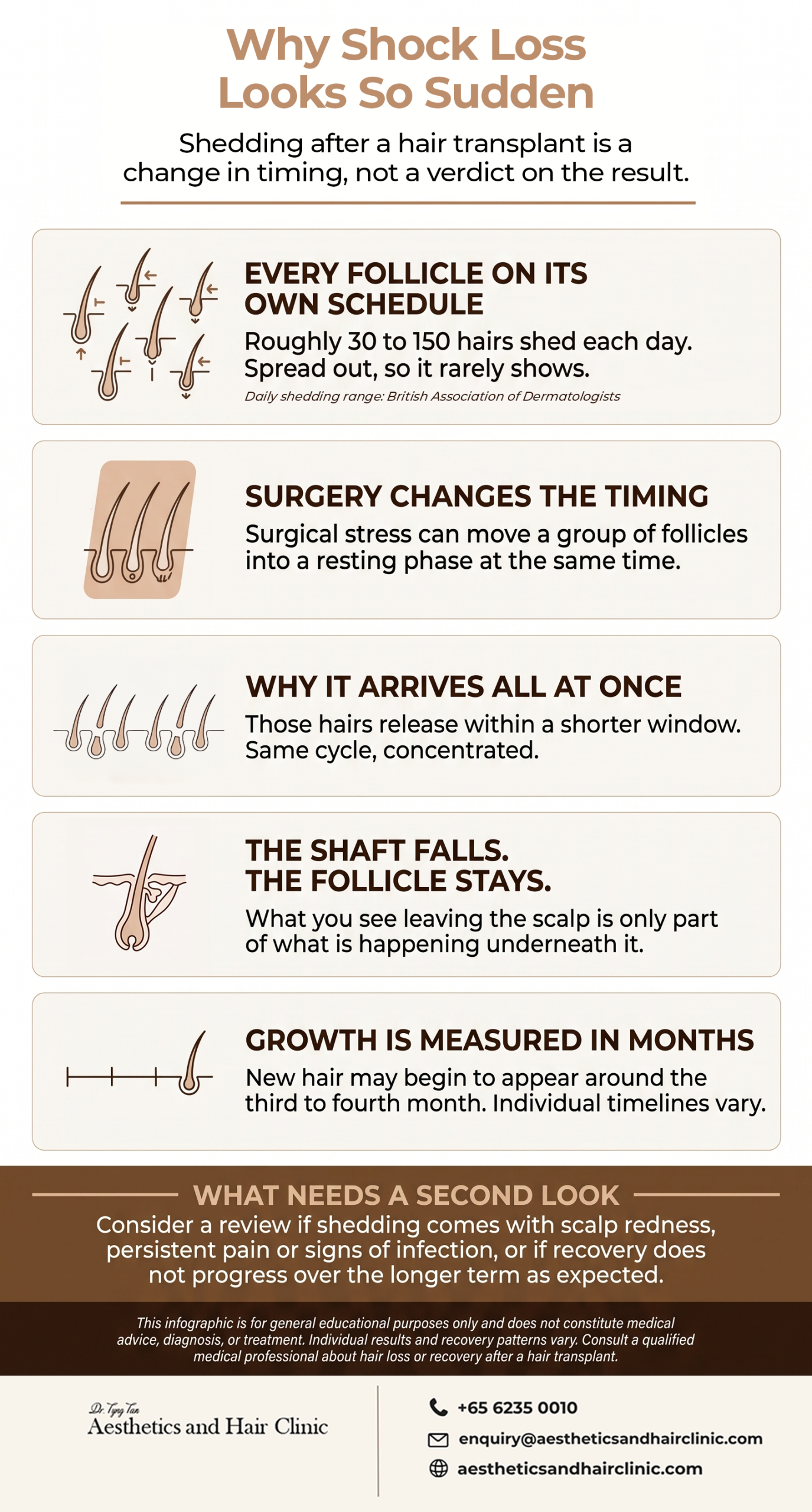
In shock loss, the visible hair shaft sheds while the follicle typically remains beneath the skin.
After its resting period, the follicle can return to active growth and produce another hair. What you see leaving the scalp is therefore only one part of what is happening underneath it.
Hair on your pillow during the first few weeks tells you little on its own.
Why Can Shock Loss Feel Like the Transplant Has Failed?
You had the procedure because you wanted to see more hair. Then you run a hand gently over the treated area and a few hairs come away.
That reaction can be hard to ignore.
You may start checking the mirror more often or looking closely at every hair that sheds. If the recipient area looks thinner for a while, it can feel as though recovery is going backwards.
If you have had a hair procedure before, seeing shedding again can bring earlier worries back, even though the current scalp still needs time before its recovery can be judged.
There is nothing unusual about feeling concerned at this stage. The visible hair has changed quickly, while the information needed to understand what that change means arrives much more slowly.
Why Does the Shedding Seem to Happen All at Once?
Hair follicles normally grow and shed on different schedules.
According to the British Association of Dermatologists, most people shed roughly 30 to 150 hairs each day as part of normal turnover. You rarely notice a sudden change because those follicles are at different points in their growth cycles.
Shock loss changes that timing in the area affected by surgery.
A larger group of follicles enters a resting phase around the same period. Their hairs are then released within a shorter window, making the shedding much easier to see.
This synchronisation is the important difference here. General telogen effluvium can affect hair diffusely across the scalp after a systemic trigger. Post-transplant shock loss is concentrated around an area that has recently undergone surgery.
The hair cycle itself has not changed. More follicles are simply moving through the same part of it together.
What Does the Surgery Itself Do to the Follicles?
Hair transplant surgery temporarily stresses the scalp and the follicles in the treated area.
Creating recipient sites, handling grafts and the inflammation that follows surgery all affect the local environment around those follicles. Some respond by moving into a resting phase.
Transplanted grafts also have to establish themselves in their new location. During early recovery, the graft may release the hair it had at the time of surgery. In cases of shock loss, the follicle typically remains beneath the surface.
That can create an uncomfortable period when the visible hair is gone and the new hair has not appeared yet. There may be very little to see during that interval.
The follicle needs time before it starts growing new hair.
Why Can Native Hair Shed Too?
The transplanted hairs are not the only ones affected by surgery.
Native follicles in and around the treated area also experience the local effects of the procedure. Some may enter a resting phase and release their existing hairs.
For someone expecting the area to look fuller, this can be particularly unsettling. The scalp may temporarily look thinner than it did before the procedure.
Native shock loss may resolve as those follicles begin producing hair again. Individual timelines and the degree of shedding vary. In some cases, particularly where native hair was already miniaturising, some native hair may not regrow.
Native hair shedding after surgery and loss of the transplanted grafts are not the same event. Looking thinner during early recovery does not, by itself, tell you what the area will look like later.
Which Hair Is More Vulnerable to Shock Loss?
Hair that is already becoming finer may have less resilience to surgical stress.
In androgenetic hair loss, affected follicles gradually miniaturise and produce finer hairs. These already-thinning follicles may be more susceptible to shedding around the time of surgery.
Location also affects exposure. Native hair closer to the treated area experiences more of the local effects of the procedure than hair further away.
Individual response varies as well. Two people may undergo similar procedures and see very different amounts of shedding afterwards.
That is where comparisons with someone else's recovery become unhelpful. Their scalp, existing hair and response to surgery are different from yours.
Shock Loss or Graft Failure: What Separates Them?
The fear behind this question is usually simple: did the transplant work?
Shock loss means the visible hair has shed while the follicle remains capable of producing hair again. Graft failure means a transplanted follicle has not established itself and does not go on to produce new hair.
Shock loss is a recognised post-transplant event; graft failure is a separate complication.
The difficulty is that the scalp cannot always show you the difference during the first few weeks. Both situations involve visible hair disappearing from the treated area.
What happens afterwards provides more information. Surviving follicles return to active growth and begin producing new hair. A failed graft does not.
This is measured over months. Trying to decide what happened by inspecting individual hairs soon after surgery can create more worry without giving you a reliable answer.
Watch: Is Hair Shedding Normal After a Hair Transplant?
When Does Post-Transplant Shedding Need a Closer Look?
Shedding on its own can form part of early recovery.
The situation deserves closer assessment when shedding comes with redness, persistent pain or signs of infection. A recovery that does not progress over the longer term as expected also needs to be reviewed.
Sometimes the concern is simply uncertainty. You can know that shock loss exists and still be unsure whether what you are seeing matches it.
That means examining the scalp, establishing when the shedding began, and reading it against the stage of recovery. Those findings can be assessed by Dr Tyng Tan or another qualified practitioner in the context of the procedure and the individual scalp.
The timing changes how those findings are interpreted. A scalp in the first weeks after surgery should not be judged in the same way as one several months into recovery.
When Does Hair Start Growing Again After Shock Loss?
The waiting period after shedding is measured in months.
Affected follicles spend time in a resting phase before returning to active growth. New hairs may begin to appear around the third to fourth month. Individual timelines vary.
The first hairs can be fine and light. They may be easy to miss when you are checking the mirror every day.
Density and thickness change gradually over the months that follow as more follicles come out of the resting phase. A single morning rarely tells you much.
For a more detailed account of the stages after surgery, the clinic's hair transplant recovery guide covers what may happen from week to week.
What Can a Follow-Up Review Tell You?
Counting hairs at home gives you a number. It does not tell you what is happening underneath the skin.
A follow-up review looks at the scalp in the context of where you are in recovery. The pattern of shedding, the condition of the treated area and later signs of growth can be considered together.
That matters because the same amount of visible shedding can mean different things at different stages.
If the scalp is healing as expected and the pattern matches early shock loss, there may be nothing that needs to change. If there are symptoms or an unexpected course, those findings can be assessed in their proper context.
Clinical interpretation helps explain what is happening at that point in recovery. Every recovery follows its own course.
What to Remember While You Wait
Seeing hairs on the towel can take you straight back to the fear that the transplant has failed. Early shedding does not give you that answer.
The visible shaft is the part that falls. The follicle underneath is the part that matters for future growth.
Recovery after shock loss takes months to assess. If shedding comes with persistent pain, redness, signs of infection, or if the longer-term recovery falls outside the course discussed with your doctor, that is the point to have the scalp examined.
Until then, follow your post-operative instructions and keep your scheduled reviews. Checking the mirror more often will not make the follicles move through their cycle any faster.
Judge it in months.
Frequently Asked Questions
Usually not. During shock loss, the visible hair shaft sheds while the follicle typically remains beneath the skin. That follicle may later produce another hair as it returns to active growth. How much hair sheds and how quickly visible growth returns varies between individuals.
Usually not. Early shedding can happen while transplanted follicles remain beneath the surface. Graft failure is a different outcome, and the distinction becomes clearer over the months that follow rather than from the appearance of individual shed hairs during the first weeks.
Hair transplantation, like any surgical procedure, carries possible risks. These may include bleeding, swelling, numbness, infection, folliculitis, scarring, poor graft growth, and shock loss (usually temporary) affecting transplanted or native hair. Results vary by individual. A clinical assessment before surgery helps identify suitability and outline specific considerations for each case.
Some shedding may still occur because follicles can respond to surgical stress. Surgical technique, post-operative care and follow-up form part of recovery management, but none can guarantee that shock loss will be avoided.
Native hair shedding around the treated area is a recognised post-operative effect. The amount varies between individuals. When temporary shock loss occurs, affected native follicles may return to active growth over the months that follow.
No. Some people notice very little shedding, while others see a more obvious change. Hair that is already thinning or miniaturising can be more vulnerable to surgical stress.
Yes. Transplanted grafts can shed the hair they had at the time of surgery. The follicle typically remains beneath the skin and may produce a new hair when it returns to its active phase.
Medically Reviewed by: Dr Tyng Tan
Dr Tyng Tan is the Medical Director of Dr Tyng Tan Aesthetics and Hair Clinic in Singapore. Her qualifications include BSc (Hons), MBBS (London), Graduate Diploma in Dermatology (UK), Diploma AAAM (USA), and Graduate Fellowship in the International Society of Hair Restoration Surgery (ISHRS).
She practises evidence-based hair restoration, including FUE/FUT transplantation, regenerative therapies, and medical hair loss management, with an approach grounded in clinical transparency and individualised assessment.
The clinic helps patients across various stages of hair loss.
Detail
Information
Specialisation
Hair Restoration · Aesthetics · Dermatology
Location
391B Orchard Road, #08-04, Ngee Ann City Tower B, Singapore 238874
This article is intended for general educational purposes only and does not constitute medical advice, diagnosis, or a treatment recommendation. Individual results and recovery patterns vary. Anyone concerned about hair loss or recovery after a hair transplant should seek a personal assessment from Dr Tyng Tan or another qualified medical practitioner.
Dr Tyng Tan · Hair Restoration Specialist · Ngee Ann City, Orchard RoadContact Us →