What to Expect Each Week After a No-Shave FUE Hair Transplant
Week-By-Week Guide to No-Shave FUE Hair Transplant Recovery

For many people in Singapore, hair loss is a reality, with industry data indicating that approximately 40% of men and 25% of women will experience some form of hair loss by age 50. While the desire for a permanent solution like a hair transplant is strong, the prospect of shaving the head often presents a major hurdle, especially for professionals, athletes, and public-facing individuals.
Fortunately, the No-Shave Follicular Unit Excision (FUE) hair transplant has emerged as a preferred hair loss treatment in Singapore for those who prioritise discretion and a swift return to daily life. This modern technique allows for the extraction and implantation of hair follicles without the need for a full or partial shave, offering a nearly invisible recovery.
The key to a successful No-Shave FUE outcome, however, lies in understanding and diligently following the post-operative recovery timeline. While the discretion is immediate, the growth is an exercise in patience. Vetted by our medical director, here is a comprehensive, week-by-week guide detailing what you can expect during the crucial early stages of your No-Shave FUE recovery. Dr. Tan Tyng Yuan, MBBS, is among a limited number of physicians approved by the Singapore Medical Council to perform hair transplantation, specialising in both the Follicular Unit Excision (FUE) and Follicular Unit Transplantation (FUT) techniques.
Phase 1: Immediate Healing & Graft Protection (Weeks 1–2)
The first two weeks are the most critical period for ensuring the newly transplanted grafts secure themselves in the recipient area. The primary benefit of No-Shave FUE is that your existing hair works immediately to camouflage the tiny extraction and implantation sites.
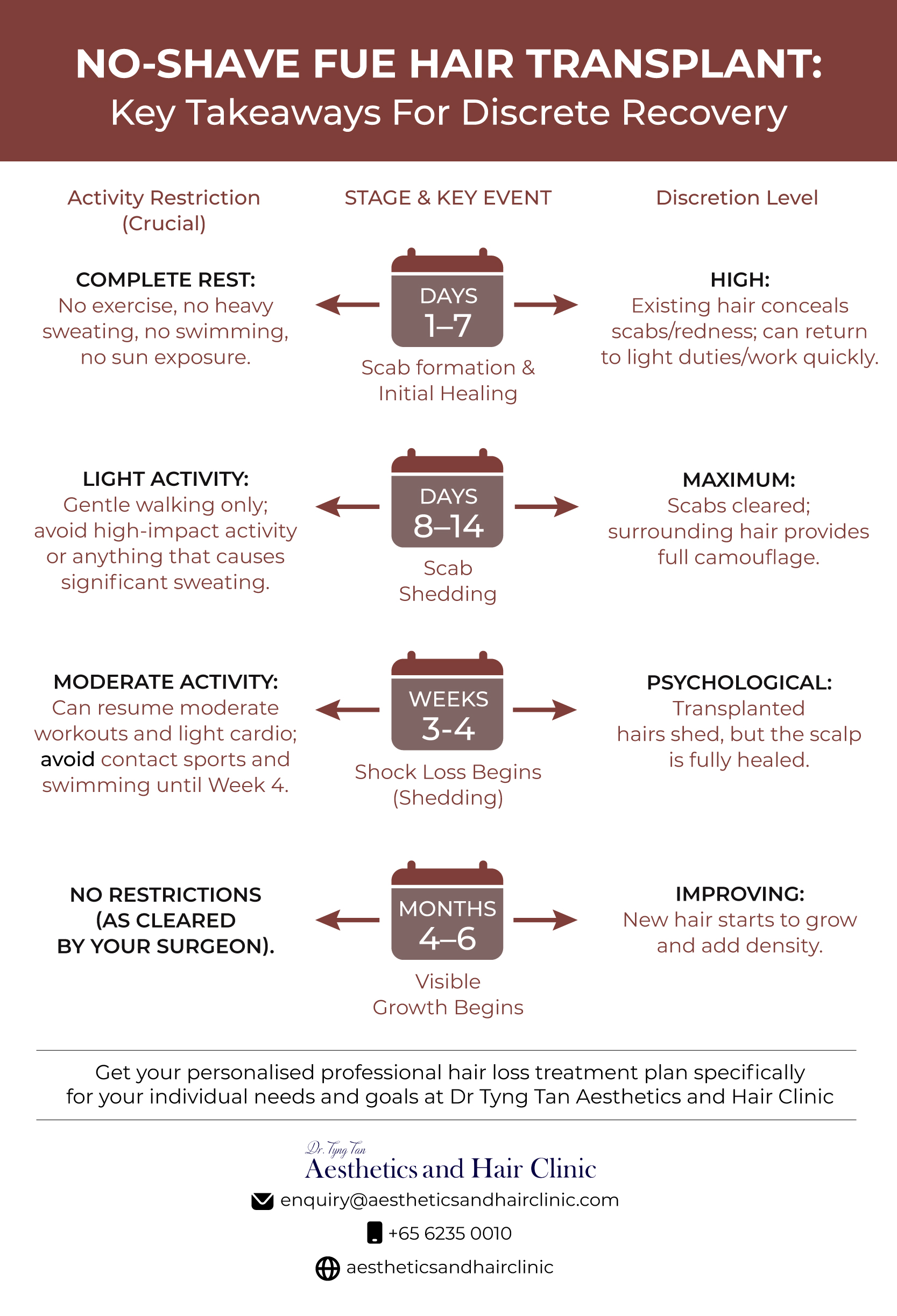
Week 1: Maximum Care and Rest
This week is dedicated to preventing infection, managing swelling, and protecting the delicate grafts.
- What to Expect:
- Day 1–3: You will likely experience mild swelling, often around the forehead and eyes, which is normal and temporary. Small scabs or crusts will begin to form around the grafts in the recipient area and over the donor sites.
- Discretion: The surrounding long hair from the No-Shave technique should immediately conceal the scabs and redness, allowing you to return to light duties or work shortly after, if comfortable.
- Discomfort: Any mild tightness or soreness is manageable with prescribed pain medication. Numbness or tingling can occur in the treated areas but typically fades within a few weeks.
- Practical Care Tips:
- Rest and Elevation: Rest is crucial. Sleep with your head elevated at a 30° to 45° angle for the first few nights to help minimise swelling. A neck pillow is highly recommended.
- Washing: Your surgeon will provide specific instructions, but generally, a very gentle first wash can start within 24 to 48 hours. This involves using a mild or baby shampoo and gently patting the areas, avoiding direct, strong water pressure or rubbing. Daily washing helps soften and remove the scabs.
- Activity: Complete rest is required for the first 3 days. Avoid all strenuous activity, heavy lifting, or anything that causes sweating for the full week. Sweating, especially in Singapore’s humid climate, increases the risk of infection and can disrupt the grafts.
Week 2: Scab Removal and Light Activity
By the end of the first week, the grafts should be secure, and you can focus on clearing the scabs gently.
- What to Expect:
- Scabs: The scabs and crusts will naturally begin to flake off, usually by day 7 to 10. It is important to continue gentle washing and light massaging (as instructed by your surgeon) to ensure they are fully cleared.
- Appearance: Once the scabs are gone, the underlying skin will show some lingering redness, but this will continue to be concealed by the surrounding long hair, maintaining the procedure’s discretion.
- Practical Care Tips:
- Exercise: Athletes and active individuals can typically introduce very light exercise, such as gentle walking, but only if it does not cause sweating or a significant increase in heart rate. Strenuous activity, heavy exercise, and swimming are still restricted.
- Scalp Protection: Avoid sun exposure, and if you must go outdoors, wear a loose-fitting hat after about day 7 or as advised by your clinic. Continue to avoid scratching, rubbing, or picking at the scalp.
Phase 2: Dormancy and Shedding (Weeks 3–8)
The period between the second and eighth week marks a crucial psychological phase known as “shock loss”.
Weeks 3–4: The Onset of Shedding
This is a normal and expected part of the recovery, indicating that the hair follicles are moving into a resting phase before new, permanent growth begins.
- What to Expect:
- Shock Loss: The transplanted hairs will begin to shed. This can start as early as 10–14 days and may continue until the end of the first month. The scalp may appear similar to how it looked before the transplant, but this is a temporary preparation for the growth phase.
- Healing: The donor and recipient areas should be fully healed externally, and any lingering redness should be minimal.
- Practical Care Tips:
- Exercise: Most patients can typically resume moderate workouts, including light jogging or cycling, after the 14-day mark. For athletes, contact sports and swimming are generally restricted for a minimum of four weeks to prevent trauma, infection, and dislodgement. Always get personalised clearance from your surgeon.
- Hair Care: You can generally start washing your hair normally (without excessive rubbing) after 14 days. Avoid harsh styling products or chemical treatments like colouring for at least four weeks.
Months 2–3: The Dormant Phase
The visible shedding slows down, and the transplanted follicles enter a resting phase (telogen).
- What to Expect:
- Minimal visible change is common during this ‘quiet regrowth phase’. The scalp is fully healed, but new hair growth has not yet emerged noticeably. This is a time for patience.
- Early, fine hair sprouts may begin to appear in some patients by the end of Month 3.
Phase 3: Visible Growth and Maturation (Months 4–12+)
From this point on, the focus shifts entirely to the exciting phase of hair regrowth and thickening.
Months 4–6: Initial Regrowth
-
- New, fine hairs begin to emerge from the transplanted follicles, gradually increasing density. These new hairs may initially be thin or wispy, but they will thicken over time. Many patients notice significant cosmetic improvement during this phase.
Months 7–12: Acceleration and Full Results
-
-
- The newly grown hair becomes thicker, denser, and begins to blend seamlessly with your existing hair.
- Noticeable results and increased density become apparent from 6 months onwards, with the final, mature results visible at 12 to 18 months post-procedure.
-
A consultation with an accredited specialist, such as Dr. Tan Tyng Yuan, is essential to understand the potential risks, benefits, and the full personalised recovery plan specific to your condition.
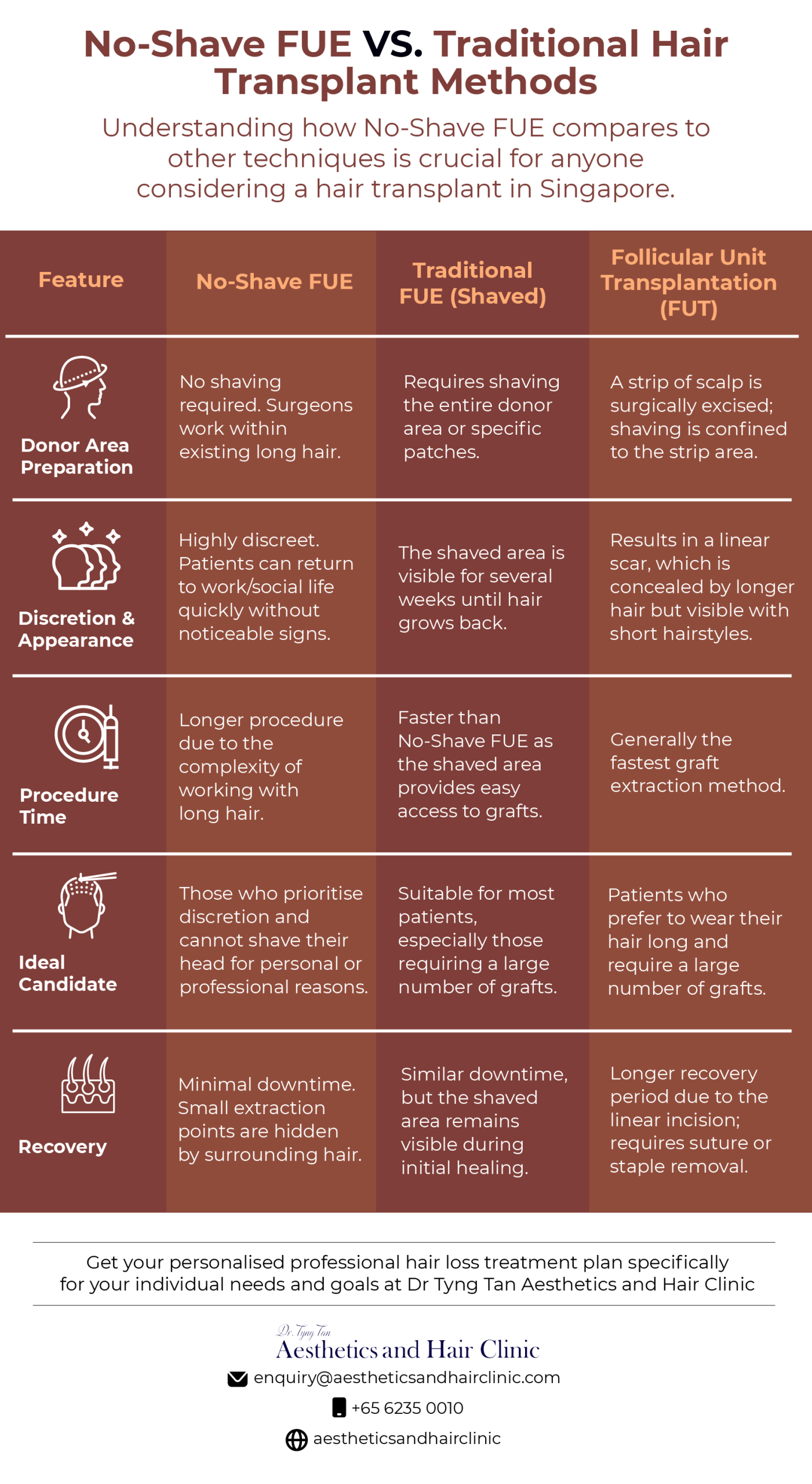
Selection Criteria For No-Shave FUE in Singapore
A successful outcome begins with a comprehensive and personalised consultation with a qualified medical professional. When you are selecting a clinic, ensure your doctor meets these crucial standards:
- Approval and Experience: The doctor should be approved by the Singapore Medical Council to perform hair transplants and possess extensive experience specifically in FUE techniques.
- Results Portfolio: The clinic should be able to show a portfolio of consistent, natural-looking results.
To begin your hair restoration goals, contact us at +65 6235 0010 to book a consultation with Dr. Tyng Tan today. She is an ISHRS (International Society of Hair Restoration Surgery) fellow and among the few doctors in Singapore accredited to perform both FUE and FUT hair transplant procedures. Our clinic offers a full range of options, including fully shaved, partially shaved, and no-shave procedures.

About Dr Tyng Tan
Dr Tyng Tan has over ten years of experience treating male pattern baldness with the minimally invasive, non-strip method known as FUE (Follicular Unit Extraction) Hair Transplantation.

Are You Showing More Scalp Than Hair? Restore Good Hair Coverage With Our No-Shave FUE.