

In the months after a hair transplant, you may find yourself checking the mirror for signs of new hair. You might wonder whether the grafts have survived, especially when the transplanted hairs begin to fall out. That early shedding is expected, but it doesn't tell you how many follicles will eventually grow. Each graft is living tissue that needs to establish a blood supply in its new position.
Visible growth takes time, so the early months are too soon to judge. If growth looks sparse at the one-year mark, your doctor can check whether the grafts are still maturing or whether something else is affecting density. For a wider checklist covering hairline, density and texture, see the clinic's guide on how to tell whether a hair transplant has worked. The focus here is on the grafts themselves.
What Graft Survival Means
A graft is a follicular unit, a natural grouping of one to four hairs. Your doctor usually takes these units from the back or sides of your scalp and places them in thinning areas. A graft survives when the unit stays alive after the move, reconnects to the blood supply and resumes its growth cycle.
Published survival figures vary widely. A review in the Journal of Cutaneous and Aesthetic Surgery found that studies often use small test areas with strong hair under favourable conditions. Growth across a full procedure in everyday practice can be lower. So a single survival percentage, on its own, says little about how your grafts will grow.
The First Few Days After Surgery
When your doctor removes a graft from the donor area, it loses its blood supply. A review by Parsley and Perez-Meza reports that harvested grafts take roughly three days to begin regaining a blood supply. Until then, they depend on oxygen and nutrients that diffuse from the surrounding tissue. This makes the hours during surgery and the first few days afterwards particularly delicate for the grafts.
You won't necessarily see damage to a graft at the time it happens. A graft that doesn't survive may only become apparent months later, when it produces no new hair. That's why the first few weeks can't show whether each graft will grow.
Why Is It Too Early to Judge at Three or Six Months?
Transplanted hair grows on a delayed cycle. Most transplanted hair shafts shed in the first few weeks as the follicles enter a resting phase. The hair falls out while the follicle remains in your scalp. You may also notice temporary shedding of existing hair near the transplant, known as shock loss. A 2026 review of FUE hair transplantation reports that this can occur two to eight weeks after surgery, with regrowth usually beginning around three months.
New hairs appear gradually and may look fine or uneven at first. They gain length and thickness over the following months. The clinic's week-by-week recovery guide covers the stages in more detail. At three months, many surviving grafts have yet to produce visible hair. Growth is often incomplete at six months, and the new hairs are still developing. Individual timelines vary.
The 2026 review advises considering a further procedure only after final growth can be assessed, typically around twelve months. Some patients may take longer to show final growth. Your doctor looks at overall growth in the transplanted area, since visible hair can't show what happened to each individual graft.
Surgical Factors That Affect Graft Survival
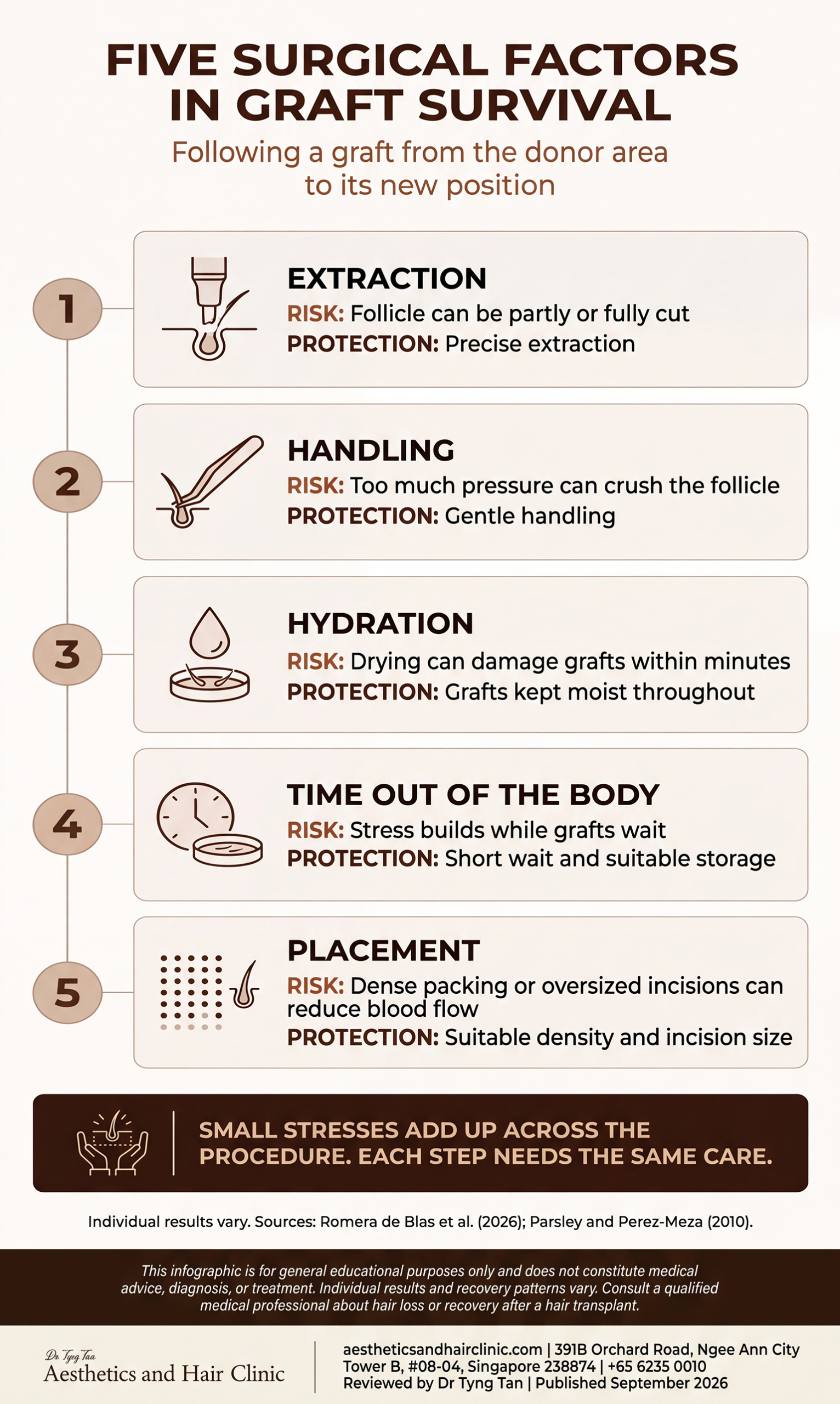
During surgery, the clinical team can influence how your grafts are extracted, stored and placed. The research cited below identifies five factors:
- Transection. A follicle can be partly or fully cut during extraction. A transected graft may grow poorly, produce finer hair or fail to grow. Published research identifies the extent of transection as one factor that may affect subsequent hair growth.
- Handling. Grafts are small and delicate. Too much pressure from forceps or implanting instruments can crush the parts of a follicle needed for regrowth.
- Dehydration. Grafts can be damaged by drying, and the effect increases with time out of solution. In a laboratory study, researchers kept isolated follicles on dry gauze for 30 minutes, then observed their growth in culture. Laboratory research suggests that dehydration may affect the growth potential of harvested hair follicles. However, laboratory findings do not necessarily reflect graft survival rates in clinical hair transplantation.
- Time out of the body. The longer a graft remains outside the scalp between extraction and placement, the more stress it may experience. The storage solution and its temperature also affect survival.
- Recipient site creation. Very dense packing or incisions that are too deep or too large can reduce blood flow to newly placed grafts.
The review by Parsley and Perez-Meza describes how grafts may experience small, non-lethal stresses throughout a procedure. These can add up and reduce survival even if no single incident causes severe damage. Careful graft handling is one of several considerations during hair transplantation, alongside the condition of the recipient scalp and individual healing factors.
How the Recipient Scalp Affects Growth
Your grafts need enough blood supply in the recipient scalp to establish themselves.
Scar tissue and areas that have been operated on before generally have poorer blood flow. If you've had an earlier transplant, an injury or surgery that left scarring, growth may differ from what happens in unscarred skin. The 2026 review identifies previous surgery, scarring and thin or atrophic skin as factors that can reduce blood flow in the recipient area.
Inflammation can also affect survival. The review found an association between stronger redness around grafts in the weeks after surgery, increased shedding and reduced graft survival. Folliculitis and washing delayed beyond three days were identified as separate risk factors for more marked redness.
Donor hair quality also affects survival. Donor hair characteristics, including hair thickness and the number of hairs within each follicular unit, may influence graft survival and the appearance of the transplanted area. Your doctor assesses donor quality before surgery, as explained in the clinic's guide to hair transplant density, grafts, and coverage.
How Much Does Aftercare Affect Graft Survival?
You have an important role in looking after the grafts, especially during the first one to two weeks while they're becoming more secure. Follow the instructions given for your procedure:
- Wash as your doctor advises. Gentle cleansing helps prevent thick crusting. The 2026 review identifies washing delayed beyond three days as a risk factor for folliculitis.
- Don't scratch, rub or pick at the recipient area. Doing so can dislodge grafts or introduce infection.
- Keep pressure off the grafts while sleeping, and protect your scalp from knocks as advised.
- Avoid strenuous activity and heavy sweating for the period your doctor specifies.
- Contact the clinic promptly if you notice spreading redness, discharge, increasing pain or crusts lasting beyond two weeks. Don't wait for a routine review.
The clinic's hair transplant aftercare guide explains these steps in more detail. Instructions differ between patients and procedures, so your treating doctor's protocol takes precedence over general advice.
Smoking and General Health
Your grafts need blood flow to establish themselves, and smoking can reduce circulation. A meta-analysis in Archives of Surgery combined studies from different surgical specialties and found more healing complications among smokers than non-smokers. It also found that programmes supporting smoking cessation around surgery reduced surgical site infections.
For hair transplantation, the 2026 review identifies smoking and vascular disease among factors linked to poor graft growth. The review also identifies smoking, diabetes and vascular disease as potential risk factors for recipient-site necrosis, a serious complication involving tissue damage in the treated area. Smoking cessation may be recommended before hair transplantation. The appropriate timeframe should be discussed with the treating doctor based on individual health circumstances. Other health conditions, medicines and supplements can affect bleeding or healing, so your doctor will review your medical history before setting a surgery date.
Can Grafts Not Grow Even When Everything Is Done Well?
Yes, occasionally. You may have less growth than expected even when the surgery and aftercare have been handled appropriately. The 2026 narrative review of FUE hair transplantation describes an unexplained pattern of poor growth called factor X in roughly 0.5% to 1% of patients despite sound technique. It suggests that differences in scalp blood supply or the follicles' ability to grow may play a part. The figure covers only poor growth with no identified cause.
Your doctor should explain this possibility before surgery as part of the discussion about risks and expected outcomes. Results are discussed as realistic ranges, without guarantees.
Assessing Sparse Growth at Twelve Months
If the transplanted area still looks sparse at around twelve months, your doctor needs to assess it before deciding why. Four situations can appear similar:
- Your grafts have survived but are still maturing.
- Your original hair has continued to thin around the transplanted area, making the result appear less dense over time.
- Your donor hair is naturally fine in texture, which can limit visible density even when most grafts have grown.
- Fewer grafts have survived because of one or more of the factors described above.
Your doctor may compare standardised photographs with your pre-operative records and examine the scalp using trichoscopy. From there, the next step may be medical management of the surrounding hair, more time or, in selected cases, another procedure. The clinic's article on long-term care after a hair transplant explains how continued thinning can change the appearance of the result.
If you've had a transplant elsewhere and aren't sure how the grafts have grown, the same type of assessment can help clarify the result. Your doctor will also examine the donor area, because the available donor hair is limited.
Dr Tyng Tan's Approach to Graft Survival
Dr Tyng Tan provides consultations and hair transplantation services, including Follicular Unit Extraction (FUE) and Follicular Unit Transplantation (FUT), where clinically appropriate.
A pre-procedure consultation may include an assessment of donor hair characteristics, scalp condition and relevant medical history. Post-procedure care and follow-up arrangements are discussed based on the patient's clinical needs. Following your doctor's aftercare instructions is the part of graft care you can manage after surgery.
These steps can't remove individual variation in healing. The clinic's FUE hair transplant page explains the procedure. If you're planning a transplant or would like your growth reviewed at the one-year mark, you can book a consultation through the contact page.
Frequently Asked Questions About Graft Survival
Medically Reviewed by Dr Tan Tyng Yuan
Dr Tan Tyng Yuan is the Medical Director of Dr Tyng Tan Aesthetics and Hair Clinic. Her qualifications include a BSc (Hons), MBBS (London), Graduate Diploma in Dermatology (UK), Diploma AAAM (USA) and a Graduate Fellowship in the International Society of Hair Restoration Surgery (ISHRS). She is a medical practitioner registered with the Singapore Medical Council. She performs FUE and FUT procedures.
| Detail | Information |
|---|---|
| Specialisation | Hair Restoration · Aesthetics · Dermatology |
| Location | 391B Orchard Road, #08-04, Ngee Ann City Tower B, Singapore 238874 |
| Phone | +65 6235 0010 |
| Fellowship | Graduate Fellow, International Society of Hair Restoration Surgery (ISHRS) |
| Website | aestheticsandhairclinic.com |
Book a Hair Loss Consultation
Dr Tyng Tan Aesthetics and Hair Clinic · Ngee Ann City, Orchard Road
Contact the clinic
Call 6235 0010 during clinic hours or submit an enquiry via the contact form.
Initial assessment
Your first visit includes a medical history review, trichoscopy, and targeted blood tests as indicated.
Personalised plan
You'll receive a treatment plan with realistic timelines and a clear picture of the long-term approach before you commit.
- Parsley WM, Perez-Meza D. Review of factors affecting the growth and survival of follicular grafts. J Cutan Aesthet Surg. 2010;3(2):69-75. doi.org/10.4103/0974-2077.69014
- Romera de Blas C, Vega Díez D, Ricart Vayá JM, Gómez Zubiaur A. Complications in follicular unit excision hair transplantation: current evidence and practical approaches. Front Med. 2026;13:1750989. doi.org/10.3389/fmed.2026.1750989
- Kim JC, Hwang SJ, Lee JJ, Oh BM, Lee SJ, Kim DW, Kim JC, Kim MK. The effects of dehydration, preservation temperature and time on the hair grafts. Ann Dermatol. 2002;14(3):149-152. doi.org/10.5021/ad.2002.14.3.149
- Sørensen LT. Wound healing and infection in surgery: the clinical impact of smoking and smoking cessation. A systematic review and meta-analysis. Arch Surg. 2012;147(4):373-383. jamanetwork.com/journals/jamasurgery/fullarticle/1151013
Medical Disclaimer: This article is for general educational purposes only and does not constitute medical advice, diagnosis, or treatment. All treatments carry risks, and individual results vary. Published study outcomes may not reflect individual treatment responses. Consult a qualified medical professional before starting any treatment. Information is current as of the date of publication and may not reflect the most recent developments. Last updated: November 2026.