Clinically Tested Hair Restoration Treatments You Can Trust
Safe & Proven Hair Restoration Solutions in Singapore
Hair loss is a common concern for men and women worldwide. Understandably so, as it not only affects a person’s physical appearance but their mental health too. The key to resolving the problem of hair loss is to first understand what it is, what it is not, and what effective treatments there are to restore a full head of hair.
Hair loss can be categorised broadly into non-scarring, scarring, and hair shaft abnormalities. Non-scarring hair loss occurs when the hair follicle remains viable and able to produce new hair. This means that non-scarring hair loss is recoverable in the future and is the most common type of hair loss. Pattern baldness and telogen effluvium fall under this category.
The next category is scarring alopecia where the hair follicle is permanently unable to produce new hair. The last category is hair shaft abnormalities. Here, there is not actually hair loss but rather hair breakage from the shaft that appears as hair loss.
In this blog article, we delve into the types of hair loss and explore effective treatments, helping you understand and manage your hair health efficiently. And we’ll throw in some essential insights and solutions for good measure, so please read on.
Signs of Hair Loss
The two most common signs of hair loss are hair shedding and hair thinning. Both hair shedding and hair thinning can occur at the same time. Hair shedding is characterised by the observable increase in the amount of hair that is shed or lost on a daily basis.
Hair thinning, on the other hand, refers to increase in the visibility of the scalp over time. One example of how this may present is noticing that you are having to wrap a hair elastic more times around your hair than usual or the volume of the hair tied or put up in a bun is much less than usual.
Unfortunately, most people do not notice hair thinning until they have lost a significant volume of hair. The good news is that there are safe and effective ways to restore your crowning glory.
How to Choose Your Treatment
The first consideration in hair restoration is diagnosis of the cause of hair loss. Different hair loss types require different approaches and only a hair loss specialist will be able to effectively address your concern. To find a qualified hair loss specialist, seek a board-certified dermatologist. This guarantees their expertise and adherence to rigorous standards. Moreover, consider a dermatologist with a particular interest or specialisation in hair loss treatment.
Dr. Tan Tyng Yuan is one such board-certified dermatologist with an MBBS from the University of London and a Diplomate in Practical Dermatology from Cardiff University. She has also published multiple scientific articles in respected journals on the topic of hair loss and hair restoration. In addition, she has approval by the Singapore Medical Council to carry out FUT (Follicular Unit Transplantation) and FUE (Follicular Unit Extraction) techniques. She is trained in fully shaved, partially shaved, and non-shaved FUE hair transplant surgery.
Proven Hair Restoration Options in Singapore
There are in-office and out-of-office options for addressing hair loss in Singapore. Of these, four have been particularly backed by scientific research and have their own strengths and weaknesses depending on the type of hair loss being addressed.
MINOXIDIL
Topical minoxidil is the most studied over-the-counter medication for hair loss. It was initially used as an oral drug to treat hypertension where patients were observed to have developed hair growth all over their body. Advances in dermatology have since harnessed and packaged this drug into a format that can be applied to the surface of the skin to induce hair growth. This is commonly sold under the brand name Rogaine. Contrary to popular belief, minoxidil may be used by both men and women, despite it being marketed more towards men. Minoxidil is available at drugstore prices and can be used to treat non-scarring alopecia.
LOW-LEVEL LASER THERAPY (LLLT)
A step up from topical treatments is the use of low-level lasers to stimulate hair follicles and promote growth. Low-level laser therapy is also known as cold laser therapy or photobiomodulation and is a non-invasive treatment that uses low-power lasers or light-emitting diodes (LEDs) to deliver light energy to the body. This light energy is absorbed by cells, which can stimulate healing. As the cells heal, they may start to grow new hair. This is effective for non-scarring types of hair loss as it can help reduce inflammation in the scalp, which can hinder hair growth. By reducing inflammation, LLLT can create a more favourable environment for hair follicles to thrive. The cost of each session in an aesthetic centre can range from S$100 to S$200.
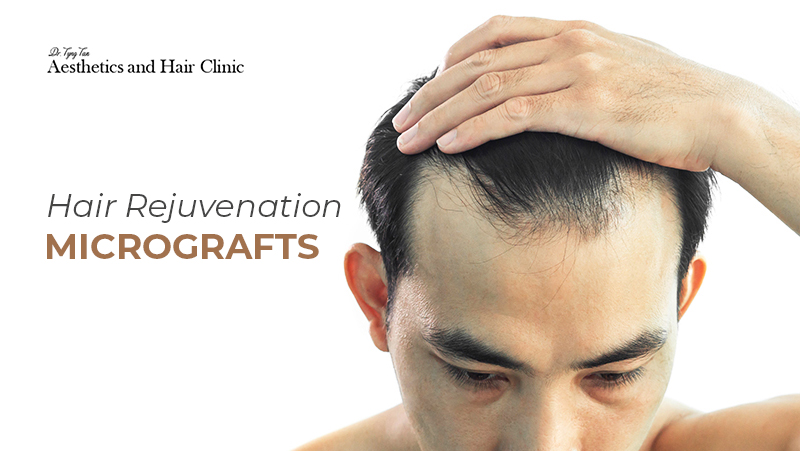
Hair Rejuvenation Micrografts
Another non-surgical hair loss treatment option is hair rejuvenation micrografts. It takes advantage of the person’s own hair follicles to stimulate new growth of hair. A small number of hair follicles are first extracted from a viable location where hair remains thick. These harvested follicles are then processed in order to isolate growth factors and proteins. The processed material is then reinjected into the areas of the scalp experiencing hair loss. Because of the growth factors and proteins in the processed follicles, dormant hair follicles are encouraged to enter into the growth phase. As with the two previously-discussed solutions, hair rejuvenation micrografts are particularly effective in addressing the non-scarring type of hair loss.
HAIR TRANSPLANT SURGERY – FOLLICULAR UNIT EXTRACTION (FUE)
When alopecia is determined to be the scarring kind, the most effective treatment is hair transplant surgery. Hair transplants involve transferring hair follicles from the back of the head to areas affected by hair loss. According to the International Society of Hair Restoration Surgery, 256,835 hair transplant surgeries were performed in 2022. This was significantly higher (by 31%) than the previous available data from 2019 and is 170% more than the number of hair transplant surgeries performed in the region in 2010. Data from all over the world shows that 87.3% of men and 12.7% of women received surgical hair restoration in 2022.
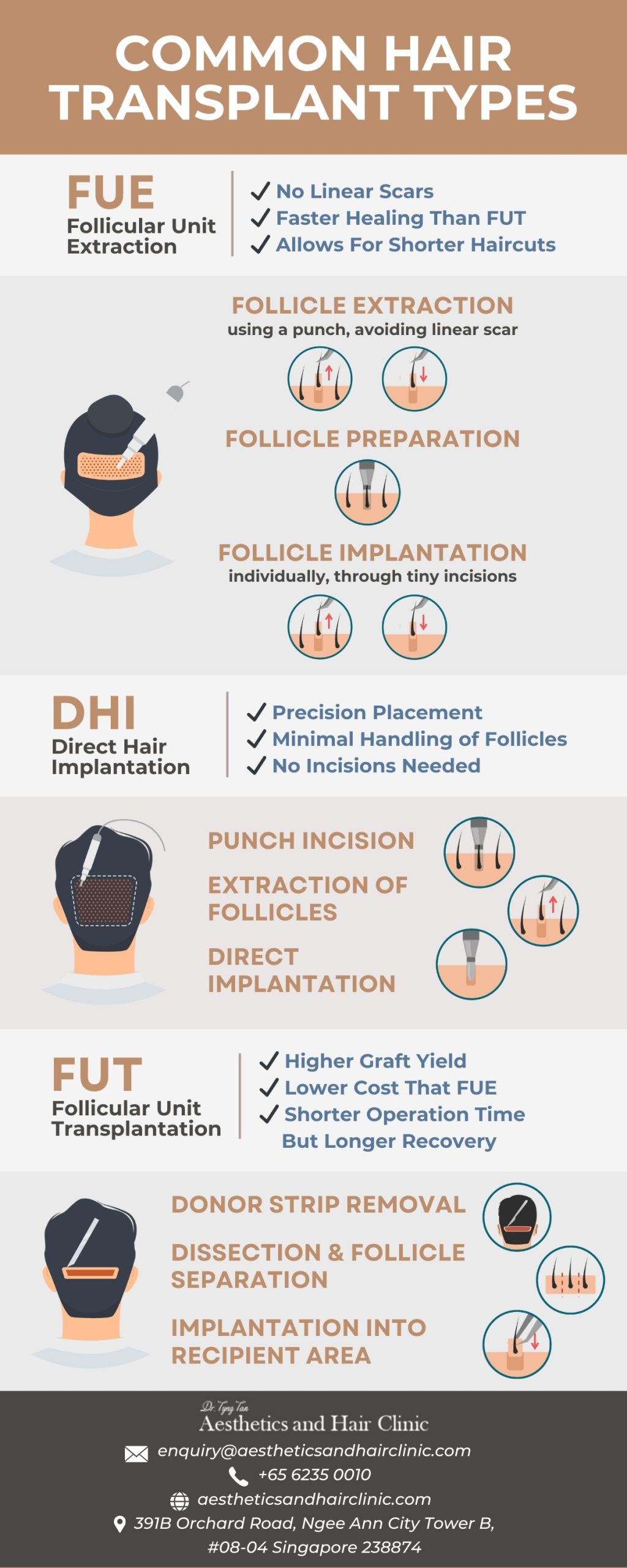
There are two common types of transplant surgeries – FUE (Follicular Unit Extraction) and FUT (Follicular Unit Transplantation). Both methods involve transplanting hair follicles from a donor area (usually the back of the head) to a balding area. However, they differ significantly in their approach. Of the two, FUE is by far the more common, representing 66.2% of hair transplant surgeries. On the other hand, 31.5% of hair transplant surgeries in 2022 were through FUT, while 2.35% used both. FUE is preferred by younger men and those who want shorter hair, as it avoids a linear scar.
Hair transplant surgery is advisable for long-term results. The transplanted hair follicles are permanent and will continue to grow naturally. To maintain optimal results, it’s essential to follow post-procedure care instructions and avoid factors that can damage your hair, such as excessive styling or certain medications.
Cost of Hair Transplant Surgery in Singapore
On average, you can expect to pay anywhere from several thousand to tens of thousands of Singapore dollars for a hair transplant in Singapore. However, it’s highly recommended to consult with clinics directly for the most accurate and up-to-date pricing information.
Choosing the right hair loss treatment specialist is key. Ensure they are board-certified in dermatology or, for transplants, a board-certified plastic surgeon specialising in hair restoration. Research their qualifications, patient reviews, and professional associations online. Consider a doctor who provides diverse treatment options and attentive care. Also, factor in clinic location, hours, and treatment costs to suit your needs.
In Singapore, specialists like Dr. Tyng Tan offer personalised advice for natural-looking results. Book a consultation to discuss your specific hair loss challenges and start your recovery journey. Schedule a consultation with us today for your hair loss concerns and to get personalised information for your specific hair loss concern.
SOURCES:
-
ISHRS. (2022). 2022 Practice Census Report. Retrieved from https://ishrs.org/wp-content/uploads/2022/04/Report-2022-ISHRS-Practice-Census_04-19-22-FINAL.pdf
-
Wimpole Clinic. (2022). Hair Transplant Statistics 2022. Retrieved from https://wimpoleclinic.com/blog/hair-transplant-statistics-2022/

About Dr Tyng Tan
Dr Tyng Tan has over ten years of experience treating male pattern baldness with the minimally invasive, non-strip method known as FUE (Follicular Unit Extraction) Hair Transplantation.

Hair loss seems like a losing battle for thousands of men in Singapore. Grow Your Hair Back To Normal With Our Safe & Minor Surgical Hair Transplant Procedure.