Your Step-by-Step Overview of Hair Loss Treatments in Singapore
Complete Hair Loss Treatment Guide in Singapore

Imagine running your fingers through your hair, only to find clumps coming away with each pass. For many in Singapore, this is not just a fear but a reality. Hair loss, a pervasive issue affecting both men and women, can stem from a myriad of causes ranging from genetic predisposition to lifestyle stressors. It’s a condition that doesn’t just strip away hair, but often confidence as well.
It’s normal to shed between 50 and 100 hairs a day. However, there are some instances when hair loss can be a cause for concern. The signs of hair loss to watch out for could be due to an underlying medical condition, nutritional imbalances, or even autoimmune disease.

Hair Loss & Mental Health
Hair loss can significantly impact mental health, leading to distressing emotional and psychological effects. Research has documented a clear association between hair loss and various mental health challenges, including anxiety, depression, and a decrease in self-esteem.

A study published in Dermatology Research and Practice found that the prevalence of depression and anxiety patients with alopecia areata included in the study were 66.7% and 73.3%, respectively. This underscores the emotional toll that visible changes in appearance, such as hair loss, can have.
Furthermore, a systematic review in JDDG: Journal der Deutschen Dermatologischen Gesellschaft highlighted the stigma and social anxiety associated with hair loss. The review pointed out that individuals suffering from hair loss might avoid social interactions and exhibit signs of social phobia. The perceived loss of attractiveness can significantly diminish self-esteem and body image, contributing to overall emotional distress.
The psychological impact is not just limited to adults. Another study published in the National Library of Medicine focusing on children and adolescents with alopecia areata reported higher rates of psychiatric disorders compared to their peers who do not have the condition. Additionally, the study notes that alopecia areata occurs more frequently in non-Caucasian individuals. Both males and females are affected at similar rates, although some research suggests that females might be slightly more prone to the condition.
These findings underline the need for a comprehensive approach to treating hair loss, to which Dr. Tan Tyng Yuan, MBBS, adheres. Today, Dr. Tan is one of a few doctors who is approved by the Singapore Medical Council to carry out hair transplantation with specialisation on both FUE (Follicular Unit Extraction) techniques and FUT (Follicular Unit Transplantation).
Autoimmune Diseases & Hair Loss

LUPUS
One of the many challenges of living with lupus is hair loss, a common side effect of both the illness and the medications used to manage it. People with lupus might notice hair becoming brittle and breaking easily around the hairline, leading to a rough appearance often referred to as “lupus hair.” While some experience a gradual thinning, others may lose hair in clumps, including eyebrows, eyelashes, beard, and body hair.
The regrowth of hair largely depends on the presence and extent of scarring on the scalp. If there’s no scarring, hair is likely to regrow once lupus is under control. However, if hair loss results from medication, managing the underlying lupus may be necessary before hair loss can be addressed. Early hair loss might also indicate lupus before it is officially diagnosed, necessitating a consultation with a healthcare provider to rule out other conditions.
GRAVES’ DISEASE and HASHIMOTO’S DISEASE
Both these autoimmune disorders target the thyroid, a crucial gland in the neck that influences numerous bodily functions, including hair growth. Graves’ disease leads to hyperthyroidism, where excess thyroid hormones are produced. Meanwhile, Hashimoto’s disease leads to hypothyroidism, which often runs in families, where the thyroid fails to produce sufficient hormones.
These hormonal imbalances can disrupt the life cycle of hair follicles, causing a condition called telogen effluvium, where hair enters the resting phase too soon and stays there, leading to hair loss. Hair loss may continue until thyroid hormone levels are stabilised through medication or other treatments. The American Academy of Dermatology Association offers a checklist for identifying whether hair symptoms may be related to a thyroid issue:
✅ Thinning or missing eyebrows on the outer edges
✅ Hair that is coarse, dull, dry, and brittle, breaking easily
✅ Soft and fine hair with excessive shedding
✅ Noticeable thinning hair or bald patches
✅ Hair grows more slowly or more quickly than usual
✅ Dry, itchy scalp with dandruff
✅ Reduced hair on legs, arms, and other body areas
SCALP PSORIASIS
Psoriasis is a condition where the immune system accelerates the turnover of skin cells, leading to the rapid generation of these cells. This results in the formation of red, raised areas covered with scaly or silvery plaques on the skin. When psoriasis affects the scalp, it can manifest as isolated patches or cover a wider area, potentially extending to the forehead, nape of the neck, or behind the ears.
Scalp psoriasis varies in severity, from minor flaking to the development of thick, silvery plaques that are not only visually apparent but also cause intense itching. While scratching might seem like a relief, it can actually exacerbate hair loss by loosening hair follicles and damaging the scalp. However, scalp psoriasis is a manageable condition and with proper treatment, the symptoms can be significantly reduced or even eliminated, allowing for the regrowth of hair in most cases.
ALOPECIA AREATA
In this condition, the immune system mistakenly attacks the hair follicles, leading to hair loss. One of the most distinctive signs of alopecia areata is the rapid onset of hair loss, typically occurring in small, round patches about the size of a coin. While some individuals may experience only a few bald patches, others may lose more hair. In more severe cases, the condition can progress to total scalp hair loss (alopecia totalis) or even complete body hair loss (alopecia universalis). Hair may regrow within a year without treatment, but the quality of hair can be different initially (finer or whiter). However, even with regrowth, alopecia areata is often cyclical, and hair loss can recur at different times.
Hair Loss Treatments Overview

TOPICAL TREATMENTS
Looking for a non-invasive way to combat hair loss? Topical treatments applied directly to your scalp are some of the most popular options. Minoxidil is an over-the-counter go-to for many to help stimulate hair growth. There are also shampoos and conditioners that contain hair strengthening ingredients. For a targeted approach, consider serums and ampoules. Applied directly to the scalp, they often contain a powerful blend of vitamins, peptides, and other hair-growth boosters.
ORAL SOLUTIONS
There are some medications that tackle the root cause from within. These come in tablets, capsules, or liquids. For one, Finasteride (prescription) combats male pattern baldness by blocking the hormone DHT, a major culprit in hair loss for men. Meanwhile, nutritional supplements provide essential nutrients like biotin, vitamins C & E, iron, zinc, and omega-3 fatty acids, all crucial for healthy hair.
TRADITIONAL CHINESE MEDICINE
In Singapore, many people embrace alternative approaches to wellness, and hair loss is no exception. TCM offers a holistic approach that considers the root cause of hair loss and promotes overall well-being. Natural herbs and formulae such as He Shou Wu (known for its potential to nourish the scalp and strengthen hair roots) and Ginkgo Biloba (believed to stimulate growth) are often combined with acupuncture and moxibustion.
SCALP MICROPIGMENTATION
Looking for a non-surgical option to create the illusion of thicker hair? Scalp Micropigmentation, also known as a scalp tattoo, might be the answer. This cosmetic procedure uses a specialised tool to deposit tiny dots of pigment onto the scalp. These dots mimic shaved hair follicles, creating a realistic illusion of a fuller head of hair. Scalp tattoo is particularly popular for those who prefer a shaved head look. It adds definition and texture, giving the appearance of a close buzz cut.
HAIR REPLACEMENT SYSTEMS
Hair systems, also known as hair replacement systems, are a non-surgical solution to having a natural-looking full head of hair. Unlike traditional wigs, modern hair systems are custom-made and designed to seamlessly blend with your existing hair. Hair systems are customisable in terms of hair colour, density, and style. This allows you to achieve a natural look that complements your individual preferences.
LOW-LEVEL LASER THERAPY (LLLT)
Want to explore non-invasive solutions for hair loss? Look no further than Low-Level Laser Therapy (LLLT). This treatment uses red light to gently stimulate hair follicles and promote growth. LLLT beams red light onto your scalp, which is believed to improve blood flow. This nourishes hair follicles and may even prevent harmful buildups that can hinder growth. LLLT is available at salons and clinics, but you can also explore home-use devices like laser combs for added convenience.
HAIR TRANSPLANT SURGERY – FOLLICULAR UNIT EXTRACTION (FUE)
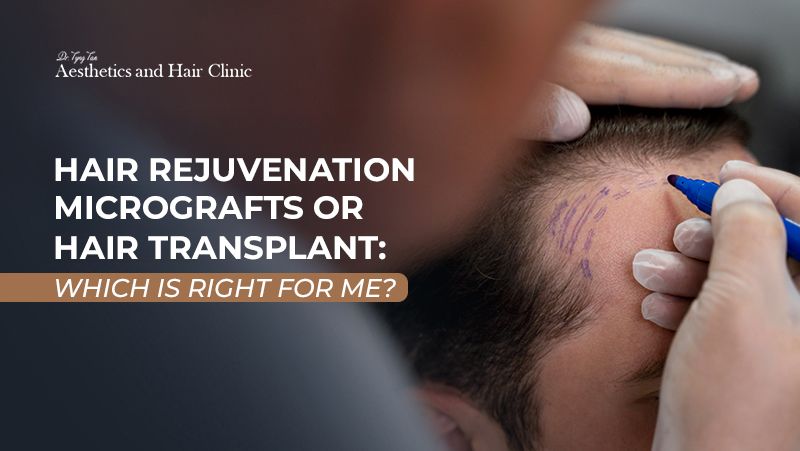
Hair transplant surgery offers a permanent option for those seeking to restore hair growth and achieve a natural-looking hairline. This procedure involves relocating hair follicles from a donor area, typically the back or sides of the scalp, to balding or thinning areas.
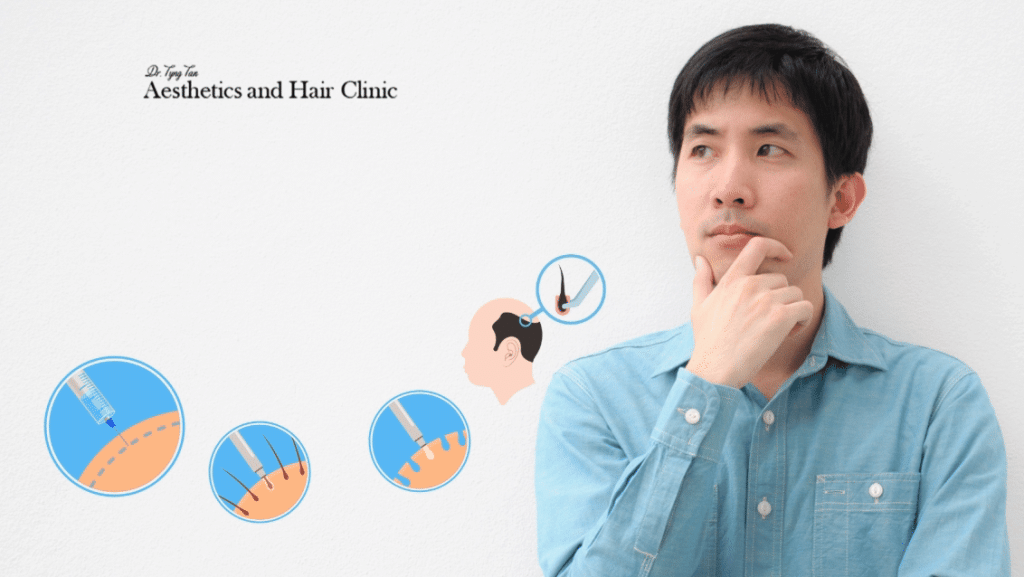
The Follicular Unit Extraction (FUE) technique is a popular choice in Singapore and around the world, and for good reason. It is minimally invasive, offers fast recovery time, and creates natural-looking and durable results. FUE hair transplant surgery involves meticulously extracting individual hair follicles from a donor area and transplanting them to balding or thinning areas of the scalp.
Finding the Right Doctor & Preparing for Consultation
Choosing the right doctor for hair loss treatment is crucial for effective results. Start by ensuring that your doctor is board-certified in dermatology, as they possess the necessary expertise to handle various hair conditions. For hair transplant, a board-certified plastic surgeon specialising in hair restoration is advisable. Leverage online resources to research potential doctors—patient reviews, the doctor’s professional background, and their membership in relevant associations can provide valuable insights.
When selecting a doctor, look for one who offers a range of treatment options and is attentive to your needs during consultations. Practical aspects such as the clinic location, operation hours, and the cost of consultations and treatments also play a significant role in your decision. Ensure these factors align with your needs for a more convenient treatment process.
In Singapore, trusted specialists like Dr. Tyng Tan can offer personalised advice and guide you towards achieving natural-looking results. Schedule a consultation to discuss specific hair loss issues and begin the journey towards regaining both your hair and a healthy disposition.

About Dr Tyng Tan
Dr Tyng Tan has over ten years of experience treating male pattern baldness with the minimally invasive, non-strip method known as FUE (Follicular Unit Extraction) Hair Transplantation.

Hair loss seems like a losing battle for thousands of men in Singapore. Grow Your Hair Back To Normal With Our Safe & Minor Surgical Hair Transplant Procedure.